
Reclamation, Tumblr and Lavender Menace: Where does the Lesbian flag come from?
Words by Milly Evans
Edited by Myfanwy Greene
Second-wave feminism was one step further towards a more inclusive society. However, like its First-wave predecessors, the movement did not come without bigotry. Second-wave feminist women were still trying to appeal to their society, as they believed this would improve their chances of achieving equality for white, cis-gendered, straight women. This involved perpetuating bigotry and removing themselves from other marginalised communities, like women-of-colour, lesbians, among other groups. The exclusion of lesbians and queer AFAB (assigned female at birth) people, created space for a lesbian feminist movement in the 70s. The group was dubbed the ‘lavender menace’ by the media, and feminists who were part of the mainstream movement. The name ‘lavender menace’ comes from the colour purple being heavily associated with female sexuality and Sapphicism. The lavender motif can be traced all the way back to Sappho, a 7th Century BCE poet, who often described the women in her poems as wearing violets. This developed overtime, resulting in the association of violet, lavender, and purple, with lesbianism.
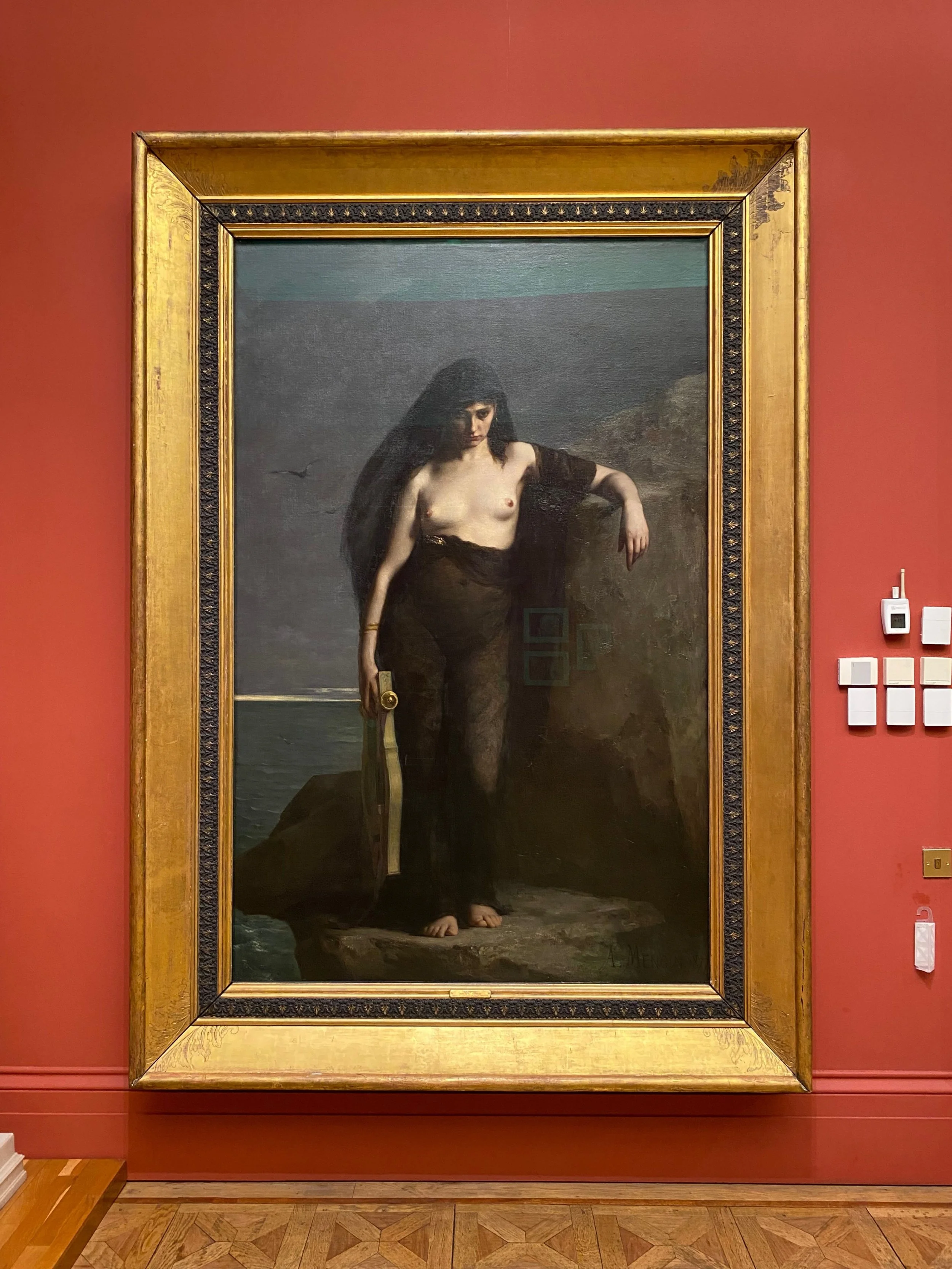
August Charles Mengin, ‘Sappho’, 1877. Manchester Art Gallery, photo by author.
Flags and symbols are an easy way to create unity and pride in a group, and so the ‘Lavender Menace’ adopted three iconic symbols of the community. The labrys, the black triangle and the colour purple. In 1999, the first lesbian flag was designed, and it incorporated these three elements. This flag is unknown to most in modern times, so I think it is important to explore what the elements mean and how they came to represent a marginalised community.
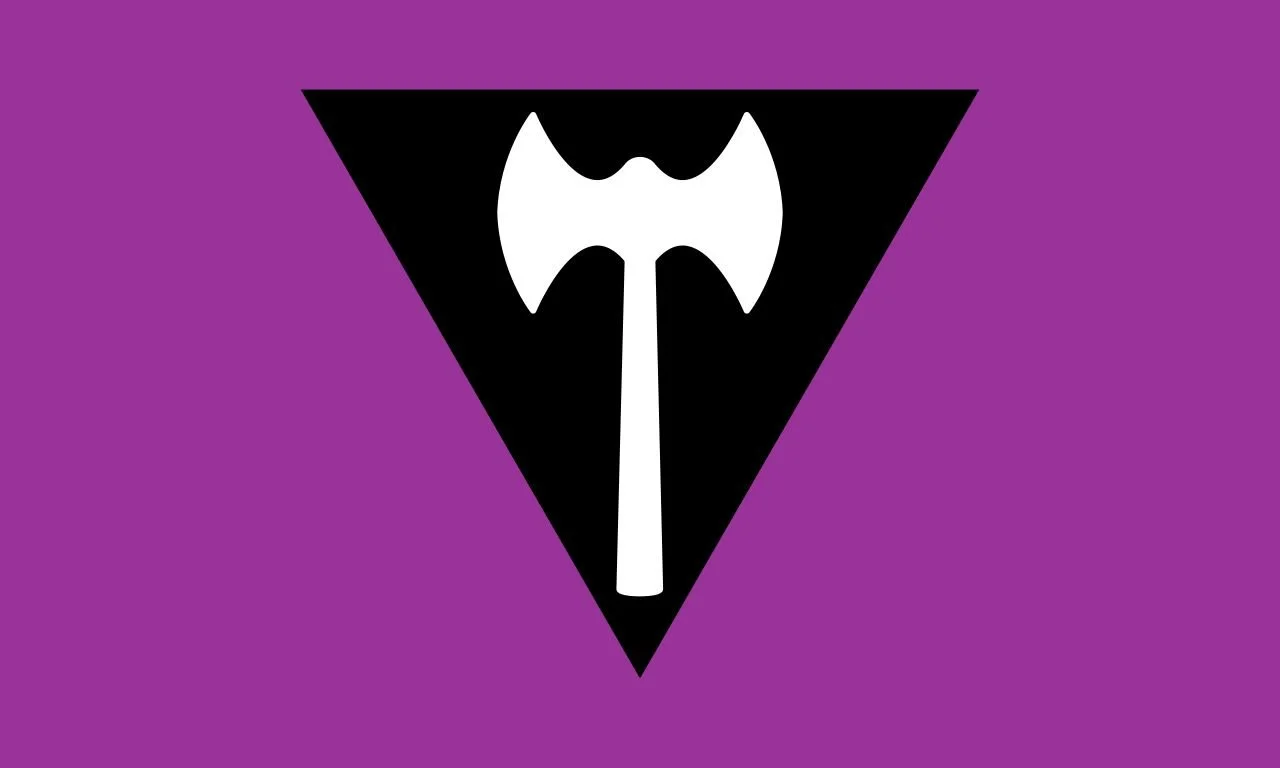
Labrys Pride flag designed by Sean Campbell in 1999.
The Labrys
Feeding from a focus on all-female communities, the labrys (a double-sided axe) became a symbol used by and associated with the 70s movement. The labrys was originally a symbol associated with the mythological Amazons during Roman Crete. The community of the Amazons were a group of female warriors, with no socialising with men permitted, apart from brief reproductive purposes. This idea of a pre-patriarchal matristic society is understandably quite desirable when viewed through a 70s lesbian lens. The labrys is often pictured with the warriors in artworks, so became highly associated with them, and adopted as a symbol of strength by lesbians.
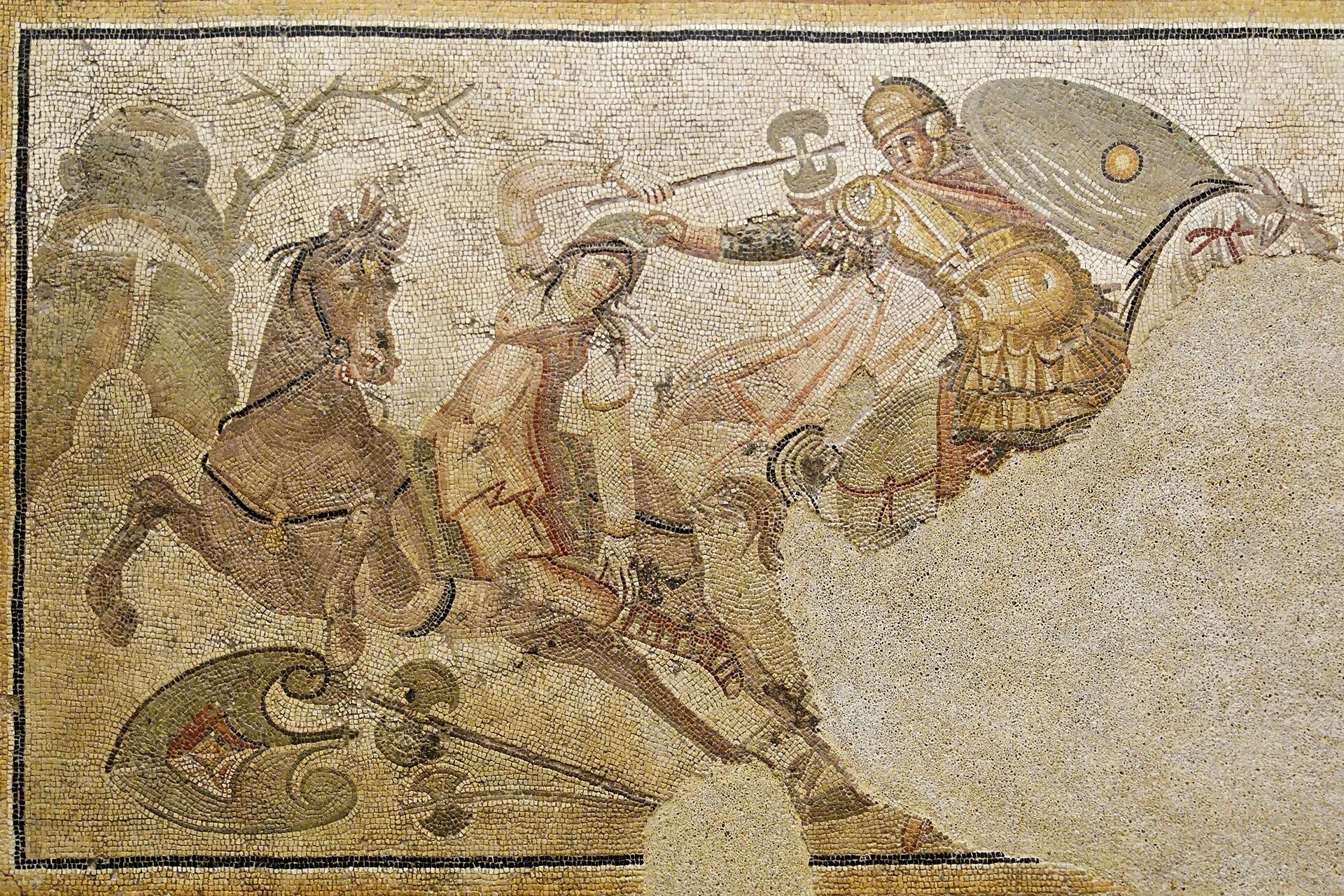
Ancient Roman mosaic with Amazon warrior in combat with Grecian, 4th Century CE.
The Black Triangle
Reclamation is another way that a symbol can come to represent a marginalised group. It is the process of taking something that is used against you, and embracing it, to uplift and empower. The ‘Lavender Menace’ had already reclaimed the name given to them by exclusionary feminists, and so they reclaimed more symbols of lesbian discrimination, one of which being the black triangle. During World War II in concentration camps in Nazi Germany, people who were imprisoned were labelled with different coloured triangle badges. Each colour had a different meaning. You may be familiar with the pink triangle as it was used on prisoners who were gay men, a symbol which has since been reclaimed. A black triangle was used to label prisoners who were ‘asocials’, this included people with disabilities, Yenish, Roma and Sinti people, and queer AFAB people. Queer women and AFAB people were not recognised by the state of Nazi Germany, so it is difficult to know why they were labelled in this category of ‘asocials’, but women who refused to reproduce Aryan children were classed as ‘asocials’, and we can deduce that many queer women were doing so. In the 70s, lesbians decided to reclaim this symbol of extreme discrimination. These three element were combined to create the first known lesbian flag (pictured earlier) in 1999, which was designed by Sean Campbell, a gay man, as a gift in solidarity with the lesbian community. A bond which had been strengthened by adversity and difficult recent times with the HIV outbreak in the gay male community.
The Labrys flag was used alongside the Double Venus pride Flag. This features the Rainbow pride flag, with the symbol of Double Venus on top. The astronomical symbol of the planet Venus is associated with the female sex, due to the planet being named after the goddess, who is the goddess of love, beauty and fertility.
These two flags hold special relevance in lesbian history, however they were not without imperfections. There were many criticisms of both. In regards to the labrys flag, the fact it was designed by a gay man was seen as an issue, as it would be a better sign of lesbian strength to have had a lesbian artist design the flag. Also the aspect of the black triangle was upsetting to some. Although reclamation can be very powerful, for your main symbol to represent the extreme pain of your community is something that can be upsetting and difficult. Acknowledging the discrimination of your community in another way, while having the flag be something that is filled with joy and pride, seems to be what the critics of this flag wanted. The main criticism of the Double Venus pride flag, was that the rainbow flag was designed for the wider community, and so instead of using that as a base, designing a specific lesbian flag would be better suited and prideful of the community.
In 2010 came the controversial Lipstick lesbian flag. This was designed by Natalie McCray, an online blogger. Lipstick Lesbian is a term for highly feminine lesbians, and the term is now seen as a controversial, mostly due to this flag. It consists of seven stripes of shades of pinks and reds, with a lip mark in the upper left corner. Some people take issue with this flag due to the colours used, suggesting that a flag to celebrate fem(me) lesbians being pink is heteronormative. Some take issue with the fact it is not inclusive of all lesbians, but there are many flags in communities to represent a smaller community within (such as bear flags), so this was not a popular critisicm. However, most take issue as McCray was found to be transphobic, racist and biphobic through her blog entries. Due to this, it never became particularly popular. There was removal of the lip graphic so it could be used as a general lesbian flag (‘Pink lesbian flag’).
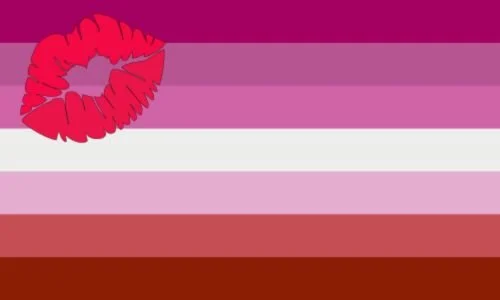
Lipstick Lesbian flag designed by Natalie McCray in 2010.
Due to concerns of the pink flag being derived from something that was exclusive of non-fem(me)s, butch flags were designed. What I interpret to be quite a direct response to the lipstick lesbian flag was designed by Tumblr user dorian-rutherford in 2016. At this point in time, we are quite removed from the idea of these historically symbolic elements being incorporated into flags, and instead leaning into stripes and having each colour indirectly represent an element of what the community is. This flag, as pictured below, has stripes in shades of blue. Criticism followed, as it again felt very heteronormative, and like a counterpart to the lipstick lesbian flag, as opposed to its own flag supporting its own community. Due to this, Jim or Mod Q fromTumblr blog butchspace designed a new butch flag in 2017. This one featured stripes in shades of oranges and yellows, which is inspired by the colours used in the blog. By looking at this blog, you can see that the colours and aesthetics of it have influenced the design of this flag. Jim declared that each stripe represents elements of the butch identity, being passion and sexuality, courage, joy, renewal, chivalry, warmth, honesty. No controversy has formed for either of these butch flags, but as they are quite niche, they are sadly not very widely used or known.
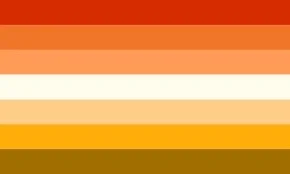
Butch flag, Mod Q on tumblr blog butchspace, 2017.
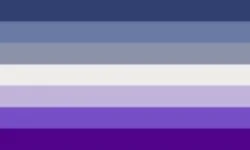
Butch flag by tumblr user dorian-rutherford, 2016.
Up until this point, the adapted lipstick lesbian flag was still the only option for the community as a whole, and so many flags were being created, but none were used by the whole community. In 2018 tumblr user sadlesbeandisaster (Emily Gwen) designed a new lesbian flag, the orange-pink or ‘sunset’ flag. This consists of the top half of Jim's butch flag above the bottom of the lipstick lesbian flag. It was designed this way ‘to subvert the idea that femininity should come first’, which is an important point to make when considering the origins of the bottom half of this flag. There is slight controversy around whether Gwen was the original designer of this flag, or just the person who popularised it, but as so many versions were around on the internet at the time, it is hard to know for certain. Similarly to the orange butch flag, each stripe has a meaning and is pictured below. Since 2018, this flag has been widely adopted and considered the official lesbian flag, along with a simplified 5-stripe version by tumblr user taqwoman.
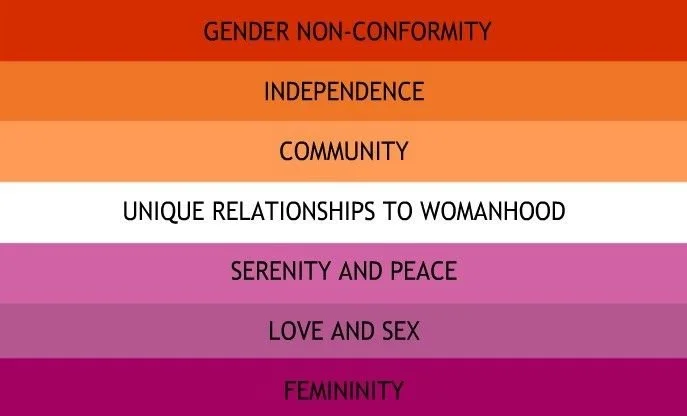
Sunset flag stripe meanings, Emily Gwen, 2018.
It is interesting to consider where the lesbian flag stems from, and how it has progressed as motives for a unified flag have changed. Following the trajectory of a need for social change, and then moving away from discrimination, to a bid for removing in-ward discrimination from such a core symbol of the community.
—————————————————
Sources/Further Reading:
https://butchspace.tumblr.com/post/162316889795/a-new-butch-flag