
Words by Georgina Way
Edited by Georgina Way
At a quick first glance it is yet another portrait of the famous queen, instantly recognisable by her smooth, unblemished and youthful face, flaming red hair and Tudor dress and it is not until the viewer stops and really looks at the painting do they realise that Queen Elizabeth I, The Rainbow Portrait, c.1600, attributed to Marcus Gheeraerts the Younger, is actually riddled with symbolism and political statements.
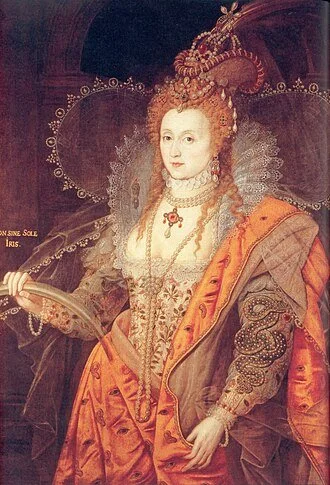
Attributed to Marcus Gheeraerts the Younger, ‘Queen Elizabeth 1, The Rainbow Portrait',’ c. 1600. Hatfield House
Painted only 70 years after The Break from Rome, the effects of her father’s decisions are clear to see. Indeed, would it even have been necessary to paint such a picture if it were not for Henry VIII’s Break from Rome and the subsequent advent of Protestantism in England and Wales? The extraordinary spy network which existed throughout the Tudor and Jacobean dynasties was largely conceived by Mary I, a staunch Catholic, to spy on the Protestants - a role hastily reversed when Elizabeth ascended the throne. Under the ruthless leadership of Walsingham Elizabeth’s spy network expanded, both across the country and abroad, weasling out plots and plans against the Queen. Whilst Walsingham was undoubtedly the Spymaster, Elizabeth played her part in cultivating the Intelligence Ring around her.
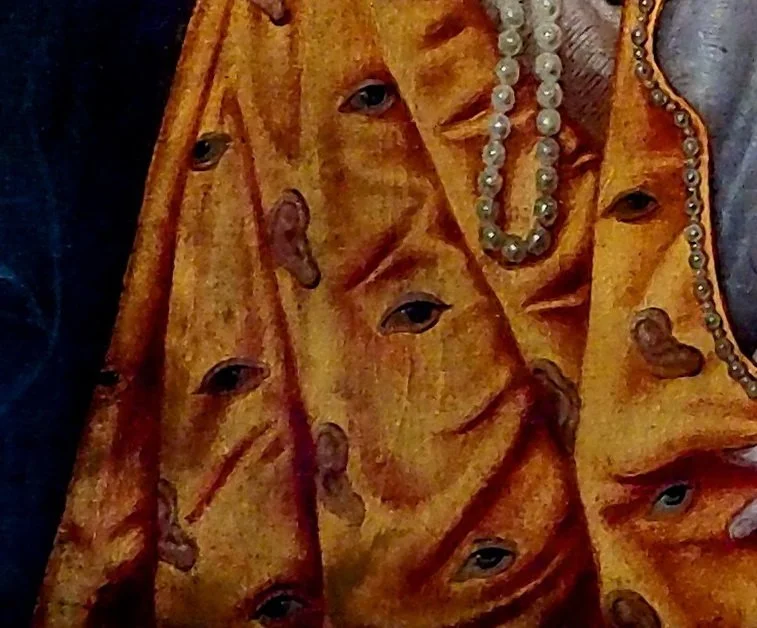
Close up of the dress of ‘Queen Elizabeth 1, The Rainbow Portrait.’
The dress in Gheeraerts’ portrait reflects both her power and that of her spy network. The eyes, ears and lips covering her dress are a reminder of her omniscience and also that of Walsingham. They reflect the feeling of being constantly watched and serve as a poignant reminder of the unease and sense of suspicion rife in the country. The 16th century was a time when knowledge was considered a great wealth and the snake on Elizabeth’s sleeve reflects that. It symbolises Athena through its association with wisdom and divine guardianship as well as, ironically, regeneration. This could be a subtle nod to Queen Elizabeth’s famous supposed virginity. The pears draped around her neck and hanging tantalisingly close to her breast also emphasise her purity and chastity. Once again, it is hinted at by the arch behind her which reminds us of the Virgin Mary through its connection to her role as the Ark of the New Covenant. The layers of ruffs behind Elizabeth remind us of halos and these, as well as the way she holds the rainbow, are reminiscent of saints shown with their attributes, suggesting that Elizabeth is nearly presenting herself as a religious figure. By holding a rainbow, she is reminding us of God’s promise. The Latin inscription just above her hand reads No rainbow without the sun thus implying that she is the sun and had brought peace to England in the form of the earlier Religious Settlement. Around her neck, she wears a pendant in the form of the cosmos which is a link to her coronation (the cosmos bears resemblance to the floor at Westminster Abbey where coronations take place. It could also be a subtle link to her mother, Anne Boleyn's, coronation) and also her understanding of her place within the cosmos as dictated by God.
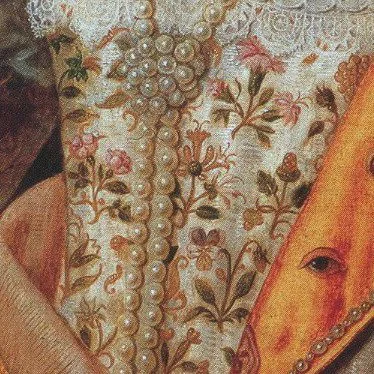
Close up of the bodice depicted in ‘Queen Elizabeth I, The Rainbow Portrait,’ Hatfield House
The painting is undeniably both a propaganda and political piece. Clipped to her ruff is a brooch in the shape of a gauntlet which represents the many young men who were prepared to fight and die for their Queen and Country. Despite her reign being smoother than that of her sister’s and father’s, Elizabeth proved herself to be a powerful and dominant figure in Europe and further afield. Her reign saw not only victories such as the Spanish Armada but also great advances in exploration with triumphant expeditions led by the likes of Sir Walter Raleigh, Sir John Hawkins and Sir Franics Drake.
Painted three years before her death, this portrait is thought to be the final one painted of Elizabeth I. By 1600 she would have been in her late sixties and yet, as in almost all portraits of her, she is depicted as a beautiful young woman. In a typically male dominated world, she understood the importance of the power of youth and beauty. Her choice of artist is likely to have been influenced by this. Marcus Gheeraerts the Younger became a renowned painter in the Tudor Court and created a new aesthetic by observing his subjects very closely and painting with very close attention to detail. For example, the flowers embroidered over the bodice symbolise her eternal youth and vitality. The level of detail depicted in this painting is extraordinary and the many complicated layers take time to unravel and understand.
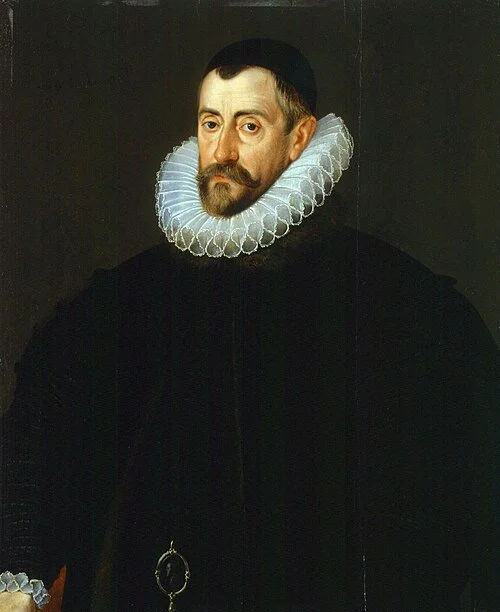
Attributed to John de Critz, ‘Sir Francis Walsingham,’ c.1585. National Portrait Gallery
It is a painting full of symbolism and hidden meanings, especially in regard to Walsingham’s spy network. Therefore, it is rather appropriate that the textile piece used to inspire this dress still survives as an altar piece in a church. It was redisocovered in 2015 and restored and, following exhibitions in Hampton Court Palace and Guildhall Art Gallery, resides back in the parish church where it was found. It seems that even today, over four hundred years later, Queen Elizabeth I is still spying on us.
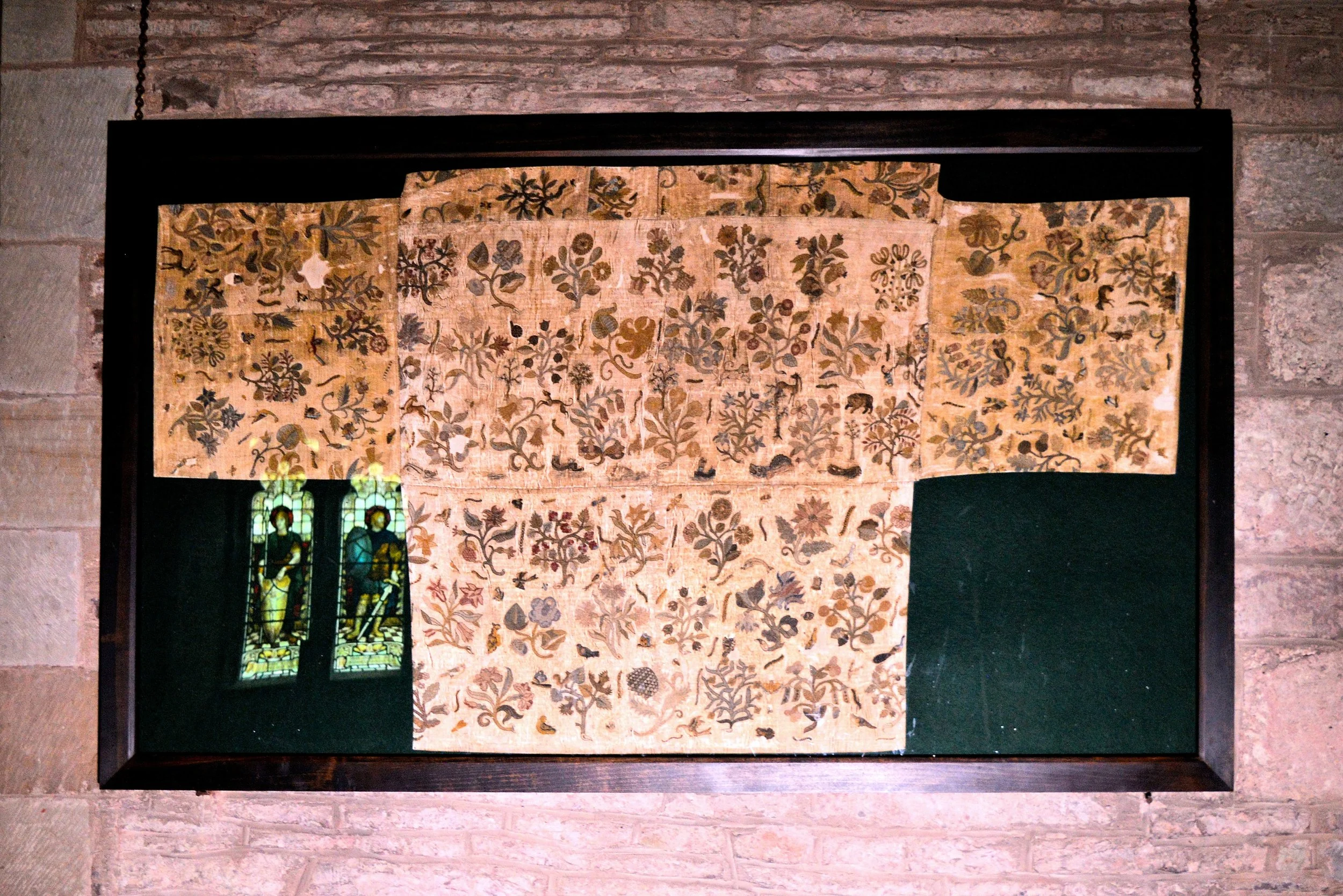
Rediscovered and restored, ‘The Bacton Altar Cloth,’ 2019. St Faith’s Church, Bacton