Frank O’Hara’s ‘Why I Am Not A Painter’ and the creative process
Words by the editor, Myfanwy Greene
Frank O’Hara, my favourite poet, was born in 1926 in Maryland and grew up in Massachusetts. He was one of the central figures of the New York School poets, alongside the poets John Ashbery, Kenneth Koch, Barbara Guest and James Schuyler, and who wrote poetry in 1950s and 60s New York. The group, and O’Hara especially, were closely associated with, and influenced by the Abstract-Expressionists, with whom they often collaborated on creative projects. These most famously included artists like Jackson Pollock and Willem de Kooning.
As well as poems, O’Hara wrote art criticism, publishing regularly in Art News, where he served as an editorial associate, writing reviews and articles. Later, O’Hara worked as an administrative clerk at the Museum of Modern Art in New York. He then ascended to the role of associate curator, albeit having no formal art history training. In his time at MoMA he curated and co-curated nineteen exhibitions, though he is still significantly less well-regarded in the art history/critical field than he is in the poetry canon.
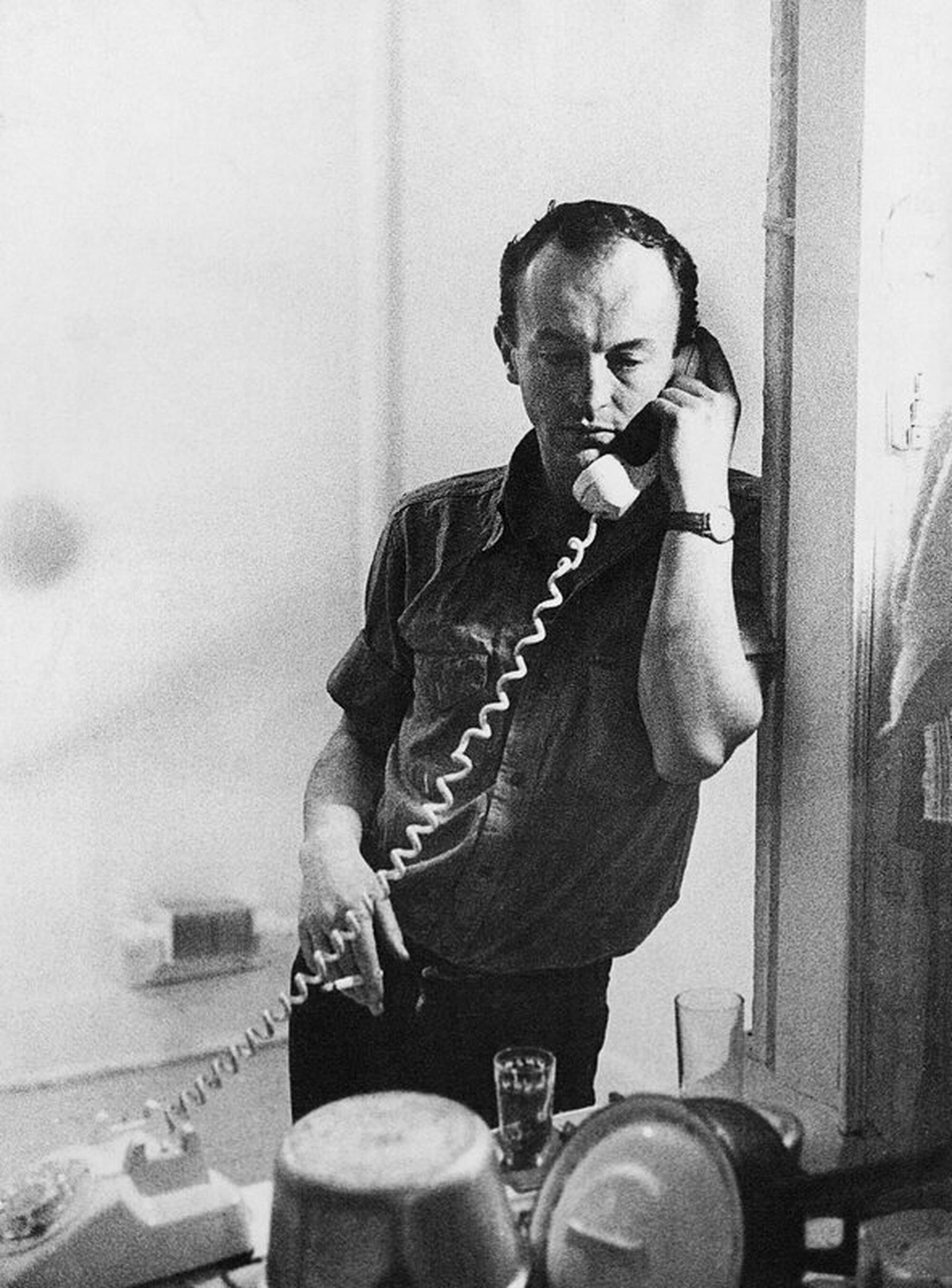
Frank O’Hara, photo credit The New York Times.
O’Hara fascination with art is prominent in much of his poetry, and in the poem ‘Adieu to Norman, Bon Jour to Joan and Jean-Paul’ he writes, ‘(sometimes I think I’m “in love” / with painting)’. Here, I will explore his love of painting, looking at the poem ‘Why I Am Not A Painter’, one of my favourites. It is a poem that explores the nature of abstraction, creation as a process and the malleability of both painting and poetry as media.
Read the poem here! https://poets.org/poem/why-i-am-not-painter
‘Why I Am Not A Painter’, a funny, light, fascinating exploration of the crossover between the artistic and poetic processes of creation. In it, O’Hara questions the intersection between the two mediums through a recounting of his experience with Michael Goldberg, who paints his famous painting ‘Sardines’ while O’Hara writes. ‘I am not a painter, I am a poet. / Why? I think I would rather be / a painter, but I am not’. Immediately, O’Hara sets himself in the role of poet, a distinct opposite to Goldberg’s painter role. The second stanza recalls O’Hara’s experience of popping in to Goldberg’s studio, and the wandering, meandering process of artistic creation. The artistic act itself gets personified in the poem, with O’Hara presenting it as an autonomous being, ‘The painting / is going on, and I go, and the days / go by. I drop in. The painting is / finished’. Removing Goldberg from the equation, it appears that with time passing it is the painting finishing itself, as opposed to Goldberg painting it. This suggests the artistic process to be one that O’Hara exists almost beyond, outside of, a space of creativity where he is not totally in control of what is being created, giving the poem a free-flowing tone that resembles the abstract, painterly brushstrokes of Goldberg. Later, we’ll have a look at the painting that O’Hara is referencing in the poem, Goldberg’s ‘Sardines’.
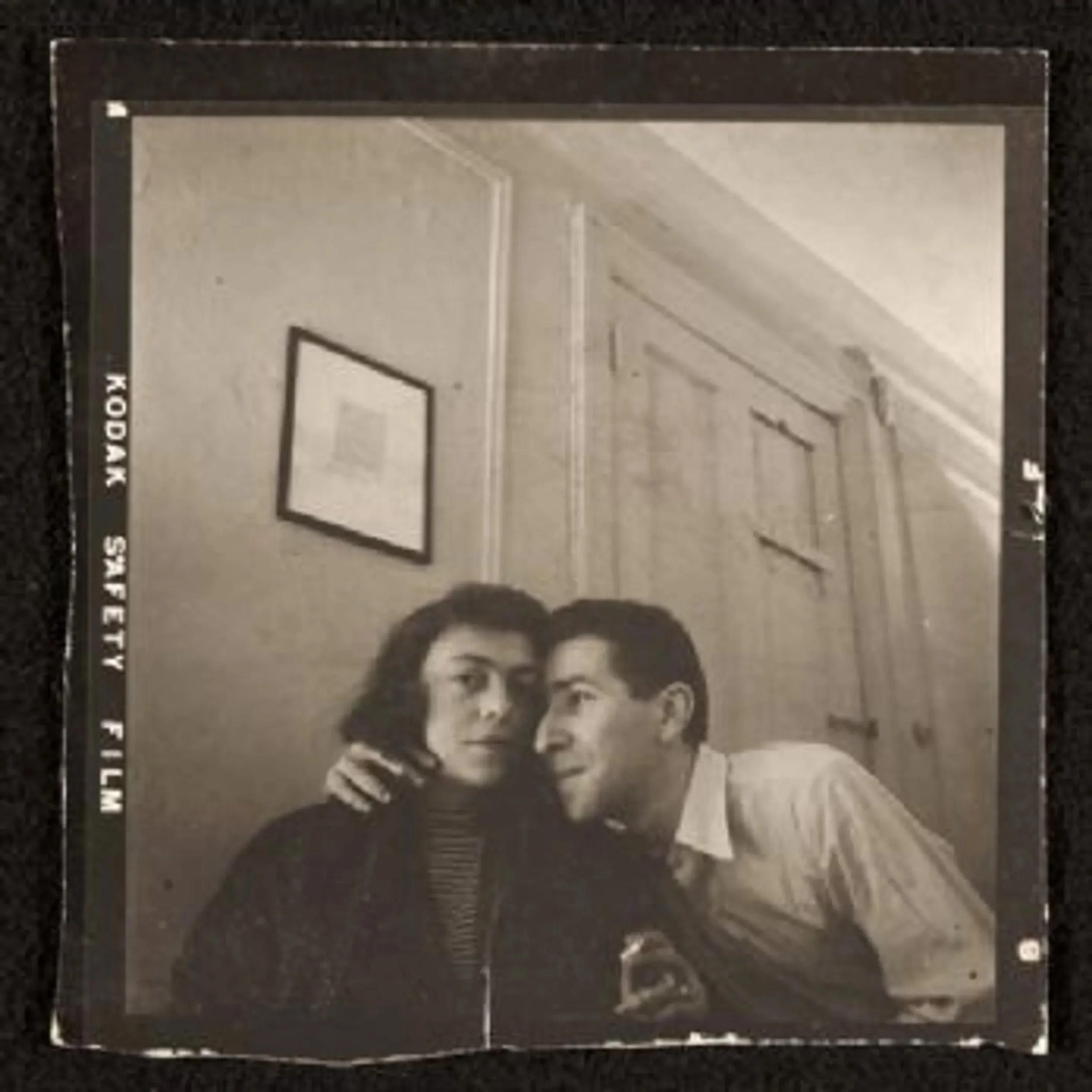
Joan Mitchell and Michael Goldberg, about 1950. Unidentified photographer, from Michael Goldberg papers, courtesy Archives of American Art, Smithsonian Institution.
In the second stanza of the poem O’Hara reflects on his own poetic process. He writes, ‘One day I am thinking of / a color: orange. I write a line / about orange. Pretty soon it is a / whole page of words, not lines.’ O’Hara emphasises the rapidity of the process of writing/creating, and the fact that so often the process appears to take us over, as many of us may have experienced. Later in the stanza he writes, ‘My poem / is finished and I haven’t mentioned / orange yet. It’s twelve poems, I call / it ORANGES’. Here, the ab-ex influence begins to show, as we get an image of O’Hara inspired by a single word that accelerates and inspires his creative process, without necessarily playing an obvious role in the final piece.
On that same note, we can turn to Goldberg’s piece ‘Sardines’. In the poem O’Hara notes that initially, Mike’s painting has SARDINES in it. That word is a big feature of the piece when O’Hara first steps into the studio. However, when he looks at the finished painting he asks ‘“Where’s SARDINES?”’, which gets the response, ‘“It was too much,” Mike says.’ Like ORANGES, SARDINES ends up being a springboard for the creative process to take off from, as opposed to a definitive feature of the final outcome. O’Hara’s poem, paired with Goldberg’s painting, reminds us that the artistic process is just as important as the end piece, and emphasises that creative journeying is a fun, non-linear, experimental avenue that deserves a gentle meandering.
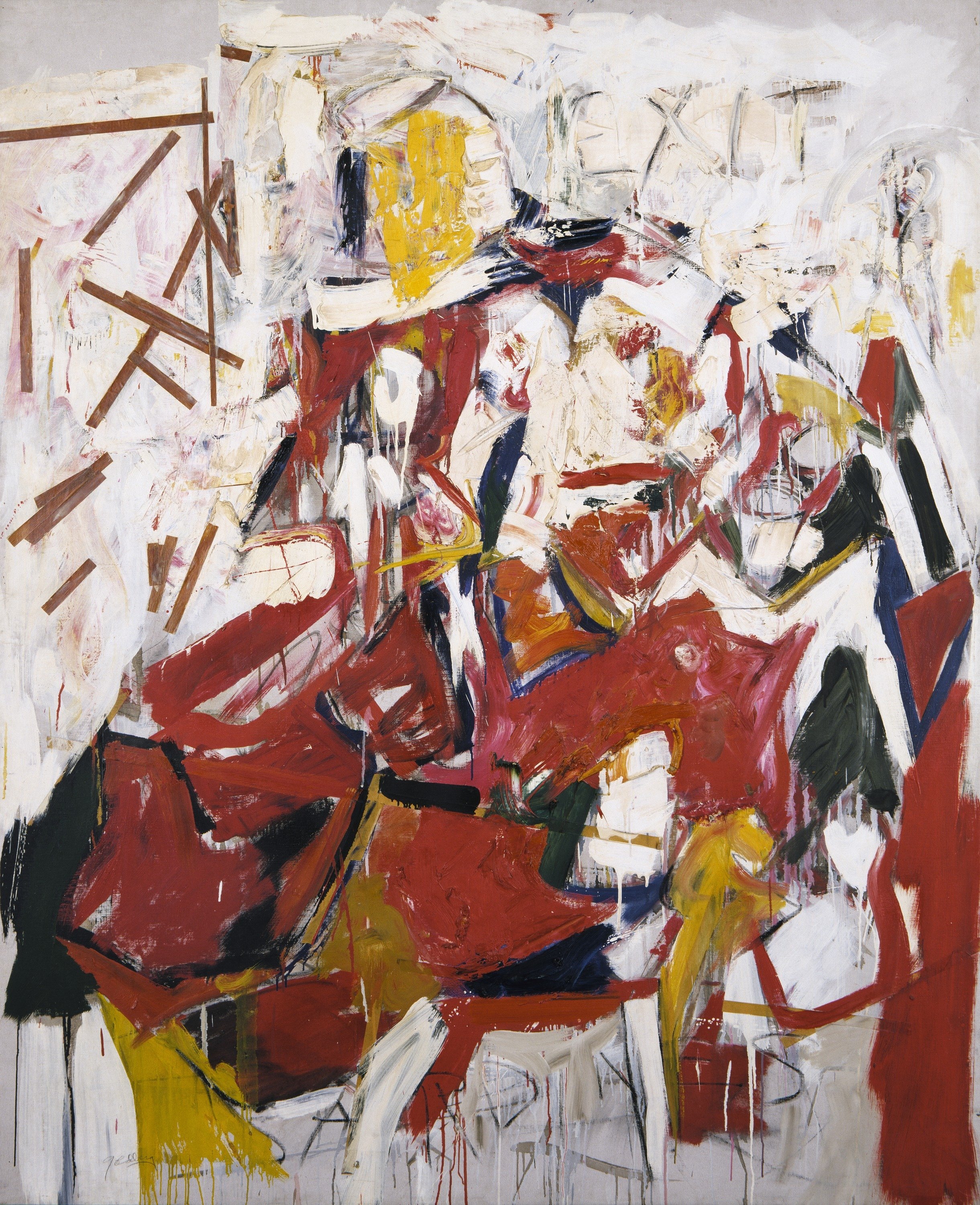
Michael Goldberg, ‘Sardines’, 1955, oil and adhesive tape on canvas, 80 3/4 x 66 in. (205.1 x 167.7 cm.), Smithsonian American Art Museum, Gift of Mr. and Mrs. David K. Anderson, Martha Jackson Memorial Collection, 1981.109.9
‘Sardines’ is a bold, colourful piece, thick with bright reds, yellows, whites, blacks and blues. It is fervent and passionate, a testament to the abstract expressionist movement, expressive and loud and intense. We can imagine how inspiring it must have been for O’Hara to visit the studios of his painter friends, looking up at these huge canvases and returning to his typewriter to abstract his words and poems as his friends abstracted their paints. The poem ends, delightfully ‘And one day in a gallery / I see Mike’s painting, called SARDINES’. It is a neatly tied up narrative, leading us from the studio, to the page, to the gallery in a way that reflects the different stages of creation all the way to the painting’s final destination — the gallery. There is a satisfactory tone at the end of the poem, a sense that O’Hara is proud of where his friend’s work has ended up.
From the studio to the page to the gallery, O’Hara tracks the creative process from beginning to end, revealing the ways in which, often, what we start with is not what we end up with — something that is not a problem, but a fact of life. He reminds us that the creative journey is not something that we have complete control over, and that there is a beauty in not knowing. Sometimes, it is better to have a go and find out!