Oppenheim, Carrington, and Kahlo: Exploring the cuisine of women surrealists
Words by Lizzy Jones
Edited by Myfanwy Greene
As well as being nourishment, food and its practices hold a myriad of symbolic and expressive meanings with which we are intimately familiar. It is fundamental to many different cultural practices, however I think many of us hardly spare more than a passing thought to how deeply it is intertwined with our everyday lives.
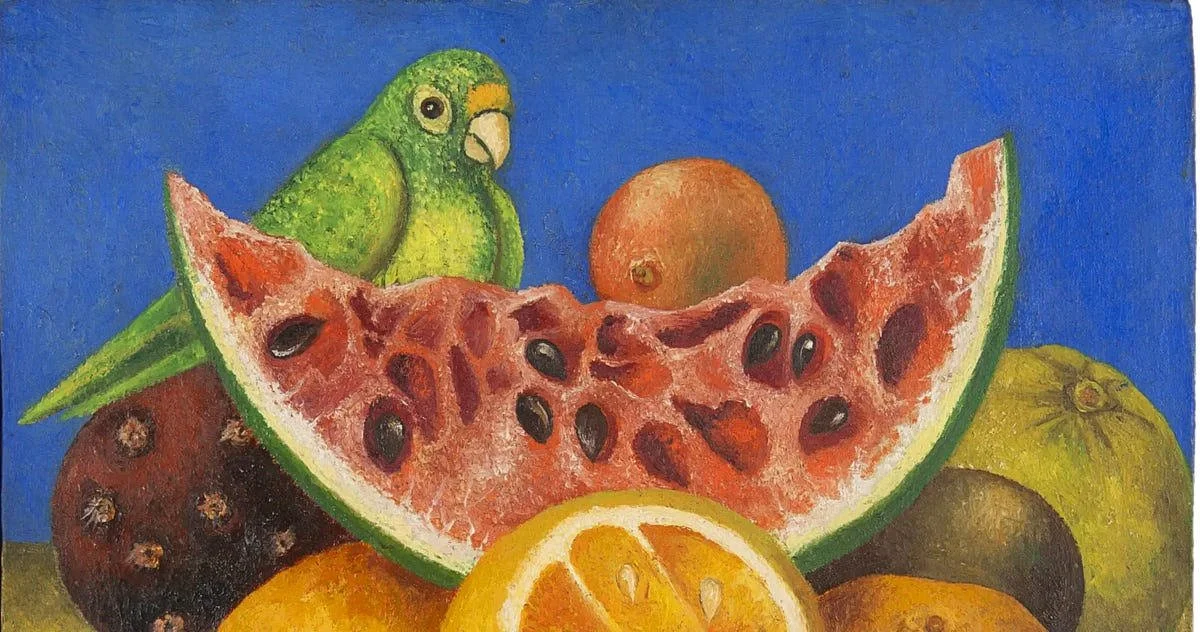
Frida Kahlo, ‘Still Life with Parrot and Fruit’, 1951.
For the Surrealists, food provides a creative and playful vehicle with which to upset our comfortable understanding of customs and the human experience. In seeking to challenge viewers to look at the world in a new, different way, what better than the very thing which sustains us? In Western culture, women are very connected to food. They are expected to prepare and serve it, as well as produce it from their bodies for babies. If food is the thing that sustains us, then women are historically its guardians. While the domain of food is where women have historically been consigned, it has equally been a way to forge strong ties and relationships with other women. Through passing down family recipes or teaching each other new techniques for cooking, women have turned food into a site of community and womanhood. For women surrealist artists, this adds an extra dimension to their play with food. I have self-indulgently chosen some of my favourite woman surrealists and my favourite works of theirs to discuss: Meret Oppenheim, Lenora Carrington, and Frida Kahlo.
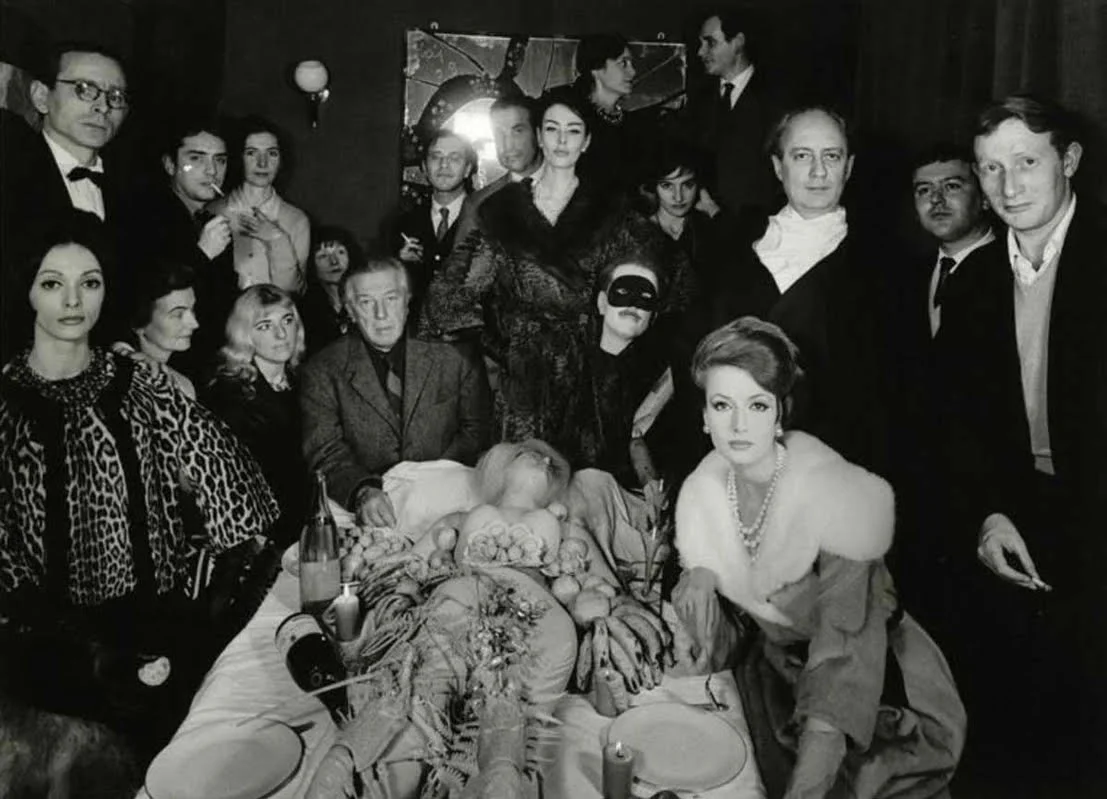
Meret Oppenheim, ‘Spring Banquet’, 1959.
When I was choosing what pieces I should use in this blog, one which stood out to me was Spring Banquet by Meret Oppenheim. This performance piece was a private event which took place in Bern in April 1959. It featured a naked woman lying on the table, with food both on her and the tablecloth. There were no observers, only participants who ate the food from her body without the assistance of cutlery. At the end of the piece, the model got dressed and joined the participants to eat the remaining food. Taking place during spring, Oppenheim intended this ritual event to be a celebration of life, pleasure, and rebirth. The woman seems to become one with the earth, equated with the soil from of which the food would grow. It celebrates the life-giving role women possess in society, and connects this role with the function of food in sustaining that life. Although playing into stereotypical and essentialising patriarchal ideas of women being closer to nature and irrationality, it was common for women surrealists to draw on symbolism of the Feminine Archetype. In this case, Spring Banquet explores Woman As Goddess or Great Mother, acknowledging the essential and powerful role of women in relation to life, in contrast to male surrealists who placed them as the femme-enfant (woman-child) or dismembered their bodies. By having the model join in with the eating at the end, Oppenheim retains her agency, rather than reducing her to an object within the performance. Oppenheim stressed that community in this piece was crucial, and through bringing together the participants through the act of eating, she celebrated femininity and removed the female body from its objectification by male surrealists as always the object of male desire.
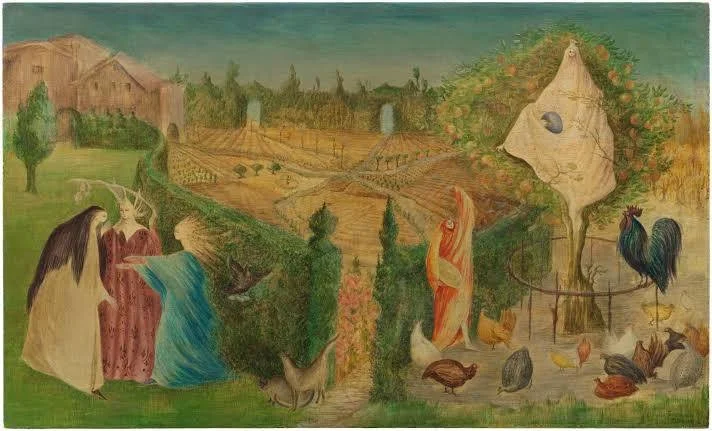
Lenora Carrington, ‘The Kitchen Garden on the Eyot’, 1946.
Lenora Carrington painted ‘The Kitchen Garden on the Eyot’ while pregnant with her son. In the background, a walled garden reaches to the horizon, with six paths converging in the centre. In the foreground, three women meet, while a white phantom holding an egg sits in a fruit tree Chickens and a red-robed figure gather around the base of the trunk.
This piece represents creation. The garden, similarly to Oppenheim’s work, connects women with spiritual and biological creation, demonstrating how like the soil grows food, the female body grows human life. The egg functions as a mystical symbol of fertility and in spiritual doctrine is the site of radical transformation. Through the imagery of eggs throughout this piece, she demonstrates how women’s bodies are similar sites of transformation and hold the immense spiritual power to give life, gaining the power to do so from the consumption of food. The three figures to the left represent Carrington and two other surrealists who were all interested in alchemy, and demonstrate the connections between women which thrived in spaces centred around food when they were perhaps not allowed to in other sites. In this piece, Carrington inverts the role that women have held in work by male surrealists, stating that ‘they only wanted us to entertain them as muses, mad or sensuous’. By creating a female dominated space and enclosing the garden (the site of creation) off from external influence, she asserts her own independent creative power, both as a woman and as an artist.
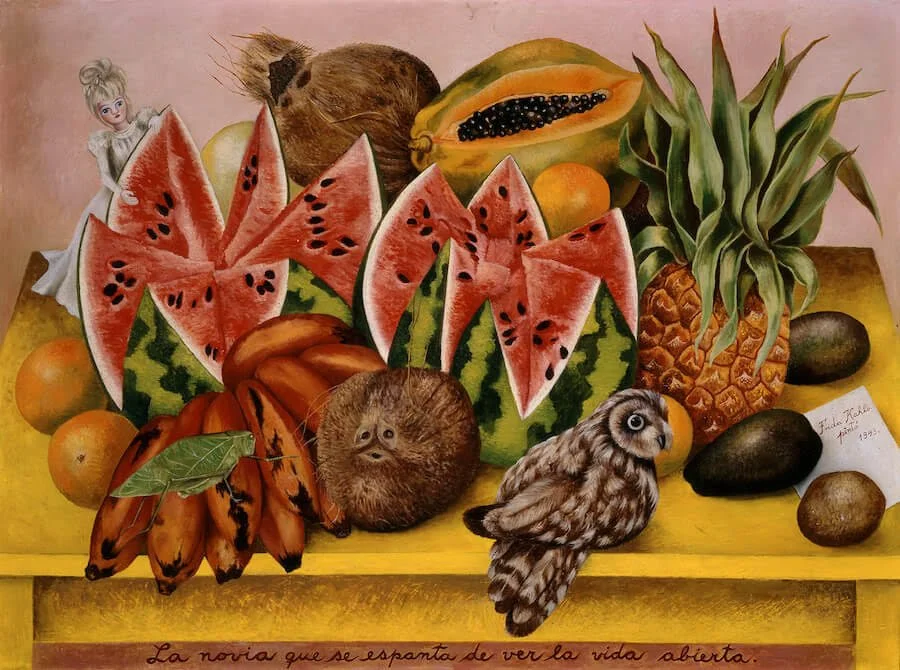
Frida Kahlo, ‘Bride Frightened at Seeing Life Opened’, 1943.
Frida Kahlo is best known for her self-portraits, but she also created several vibrant and gorgeous still-life paintings. In the hierarchy of art, still-life has almost always been relegated to the bottom, largely due to its connection to the domestic, the woman’s domain. This has meant they have historically been trivialised. However, as is particularly obvious in this still-life ‘Bride Frightened at Seeing Life Opened’, they could be incredibly vibrant and meaningful works. The bride is represented by the doll, who peeks out from behind the opened watermelons. The work has lots of erotic symbolism, with the bananas and opened papaya representing male and female genitalia.
Kahlo created this work based on the relationship between André Breton, the father of surrealism, and Jacqueline Lamba. It was created around the time Lamba left Breton and took her daughter to go stay with Kahlo. Lamba is represented by the blonde doll, and the bright colours and luscious, erotic scene before her represent the life she could seize now she was no longer tied to Breton and an ‘ornament’ of surrealism. While women were expected to be the object of male desire, rarely were they allowed to express their own sexuality. In a literal sense, Kahlo shows these sexual desires laid out like a feast for Lamba to enjoy after leaving Breton, if she can overcome her fear and seize them. While the previous two works connect food and fertility, Kahlo here equates food and sex, both central to the continuation and enjoyment of life, and demonstrates how women should be equally allowed to ‘feast’ on their desires.
Check out NRG’s Food for Thought: a Tasting Menu, up until February 27th 2026.
Sources:
Stronciwilk, Agata Anna. 2023. "Between Spring Banquet and Cannibal Banquet: Cannibalistic Imagery in Meret Oppenheim’s Works" Arts 12, no. 2: 52. https://doi.org/10.3390/arts12020052
Adler, Soloman. 2020. Leonora Carrington, the kitchen garden on the eyot, 1946, SFMOMA. Available at: https://www.sfmoma.org/essay/leonora-carrington-the-kitchen-garden-on-the-eyot-1946/.
Grimberg, Salomon. “Frida Kahlo’s Still Lifes: ‘I Paint Flowers So They Will Not Die.’” Woman’s Art Journal 25, no. 2 (2004): 25–30. https://doi.org/10.2307/3566514.