Words by Georgina Way
Edited by Georgina Way
John. It is estimated that nearly 10% of Allied soldiers who died during the First World War were called John. Two of them have been immortalised in the history books due to their very different yet equally poignant and painfully chilling depictions of the brutality which humanity is capable of inflicting upon itself.
One hundred and eleven years ago John McCrae penned his famous poem In Flanders Field. One hundred and seven years ago John Singer Sargent painted the harrowing Gassed.
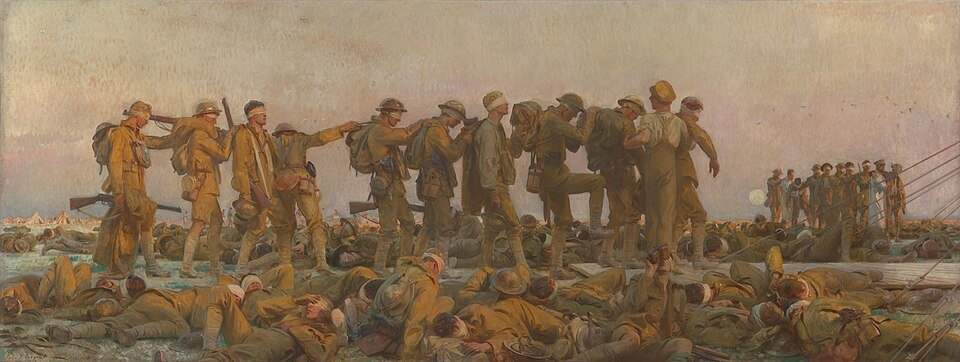
John Singer Sargent, Gassed, 1919, Imperial War Museum
Over the last century both these works have become famous, renowned for their passionate, fervid and tormented accounts of the trenches but they have also provided more than that. They have served as a warning; as a plea to the next generation and the next to remember the lessons learnt from the Great War, to honour those millions who died for our today and to live because life is short.
John McCrae, a Canadian poet, wrote what would become one of, if not arguably the most, famous poems of the First World War after attending the battlefield funeral of one of his closest friends in May 1915. It was first published in London later that year and was immediately lauded for its focus on the transition between life and death.
Gassed was painted in 1919 by American expat artist John Singer Sargent and depicts the horrors of the aftermath of the first mustard gas attack. Like the silent weapon whose aftereffects it delineates, the painting is deceptive. The warm, earthy colours of the setting sun are summery, welcoming and nostalgic. However our gaze is not drawn to the rising moon nor to the football match in the background but to the rows of soldiers, whose unseeing eyes are heavily bandaged and who walk in a line and also to the many bodies of men lying on the ground, exhausted and injured. The painting bears striking similarities to the photographs taken of blinded British soldiers after the 1918 gas attack during the Battle of Estaires
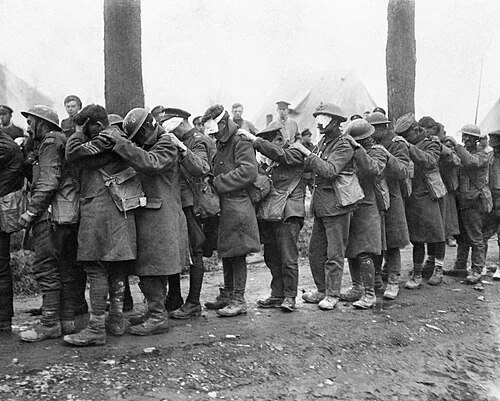
One of the photographs believed to have inspired Singer Sargent
It is so easy to look at Gassed either at the Imperial War Museum where you are separated from the picture by a rope, so as to keep it safe, you know. Ironic really, given the subject matter the painting is depicting. Or view it online and zoom in on parts of the picture and say “oh, how terrible.” It is easy to sit and listen to someone recite those well known sentences and vaguely nod our heads and agree that the poppies do indeed blow in Flanders Field. But it should not be easy. It should be almost impossible for us to look at those dried oil colours without feeling our eyes sting; without feeling a sense of internal pain. If we look at that painting and only feel the surface level response of “what an awful thing” then surely we are as blind as the soldiers depicted? Perhaps more so because we are refusing to see. We are refusing to allow the subject matter to affect us.
Equally, with the poem, we are refusing to acknowledge what we are being told. For our generation today, arguably the first generation to be totally removed from the First World War - having no living relatives who were alive, much less remember that war - the battles of Passchendaele and the Somme and Ypres seem so distant and consequently we are ignoring the plea made by McCrae. We have not taken the torch and held it high. Have we really kept the faith with those who died for our tomorrow?
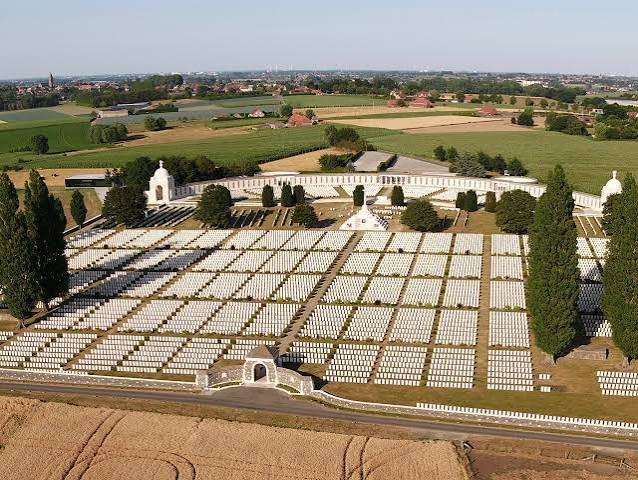
Aerial view of Tyne Cot Cemetery, the largets Commonwealth War Cemetery in the world, holding nearly 12,000 graves (known and unknown)
Today on a walk we might pass a war memorial and maybe we’ll pause briefly and read a few names because that is all they will be. Names. And yet they were loved and loved. They saw the glow of the sunset. This line is all the more poignant when you consider Gassed and the fact that the soldiers are blindly walking into the sunset, most of them never to see again.
We do not need to drastically change our lives in order to “take up the quarrel with the foe.” The foe has changed. To our generation, the foe could be AI, it could be Trump or Putin or the various sexual assault cases we read about in the news. But a step towards fighting that fight could be stopping to listen to nature. To listen to the lark singing and flying. To walk forwards with a strong moral compass, knowing what is right and vowing to do what is right, even though it is so often difficult to do so.
In this day and age, when life often so un-obligingly gets in the way and everything is rushed and frenzied, take a moment to pause. Go and play that football game as the moon rises. Feel the dawn and listen to the singing birds. Watch and see the sunset glow.
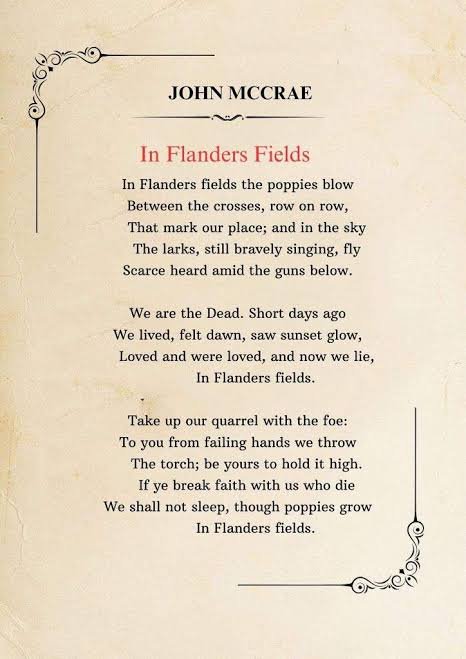
John McCrae, In Flanders Field