
Words by Lauren Walker
Edited by Georgina Way
Pumpkins are now synonymous with seasonal activities and Halloween festivities, particularly the tradition of carving jack-o'-lanterns. Yet, beyond these familiar associations, pumpkins occupy a more complex position within art history. From their historical connections to colonial expansion; to their reinterpretation by contemporary artists, pumpkins offer a fascinating insight into how the representation of everyday objects can evolve over time, reflecting changing cultural meanings and values.
The pumpkin is among the oldest cultivated crops in the Americas. Archaeological evidence suggests that pumpkins were domesticated in North America more than 7,500 years ago. For many Indigenous communities, they were far more than a source of food. Every part of the plant served a purpose, providing an important source of nourishment, while the dried outer shells and gourds were repurposed as water vessels and storage containers. Pumpkins were therefore deeply embedded within Indigenous agricultural practices and everyday life long before the arrival of European colonists.
When European settlers arrived in North America, they quickly adopted pumpkins into their diets, recognising their ability to thrive in a variety of growing conditions. However, as unfamiliar produce from the Americas became increasingly accessible in Europe, its novelty and exotic appeal reflected a growing European fascination with the resources of newly encountered territories. The pumpkin's cultural transformation also extended into seasonal traditions. In Ireland and Scotland, turnips had traditionally been carved into lanterns as part of Samhain celebrations and related folk customs. As these traditions developed within North America, the pumpkin gradually replaced the turnip as the preferred material for jack-o'-lanterns. Its larger size and softer interior made it considerably easier to carve. Over time, this adaptation helped establish the pumpkin as an enduring symbol of autumn and Halloween, demonstrating how objects and traditions can acquire new meanings as they move between cultures and geographical contexts.
Yet the pumpkin's transformation extended beyond its adoption into European diets and seasonal folklore. As it entered European visual culture, it also became a subject through which artists could explore and communicate more complex ideas. A particularly striking example can be found in Giuseppe Arcimboldo's sixteenth-century painting Autumn (1573).
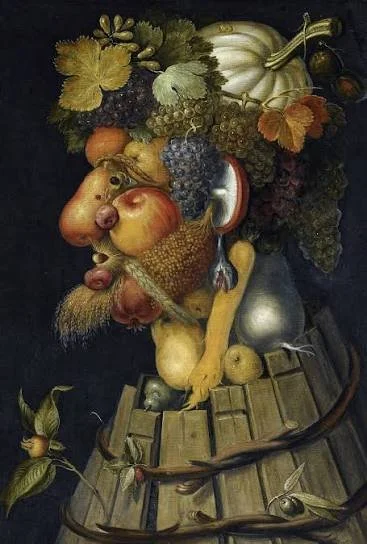
Giuseppe Arcimboldo, Autumn, 1573
Arcimboldo is best known for his ability to construct anthropomorphic portraits from arrangements of vegetables and other botanical forms. However, the inclusion of produce originating in the Americas within works carries significance beyond its unusual visual appearance.
During the sixteenth century, unfamiliar crops from across the Atlantic were gradually being introduced into Europe through transatlantic exchange, bringing with them associations of geographical discovery. Importantly, Arcimboldo's portraits were produced for the Habsburg court under Emperor Maximilian II. This places the compositions within a wider context. And can be seen as way of communicating more subtle messages about imperial authority. By incorporating an extraordinary variety of botanical forms, Arcimboldo's work could suggest not only agricultural abundance but also the influence and expansive reach of the Habsburg Empire.
In Autumn, the figure's head is constructed from an elaborate arrangement of fruits and vegetables, with a prominent pumpkin forming part of the cranium. To a contemporary viewer, the composition might initially appear whimsical; however, within the context of the Renaissance court in Vienna, these portraits also invite a reading of political power. While portraits such as Autumn can be interpreted through these markers of association, the symbolic meaning of the pumpkin was by no means fixed. As pumpkins became increasingly familiar and widely circulated throughout Europe, their cultural associations gradually evolved. Their appearance in literature and folklore, most notably through the familiar imagery of Cinderella, further reinforced their place within popular culture.
By the nineteenth century, pumpkins were increasingly represented in still-life compositions and realist painting, reflecting their growing familiarity within everyday life. Their inclusion offered artists an opportunity to demonstrate their technical ability to capture the vegetable’s distinctive form. Yet they were no longer associated primarily with discovery, pumpkins increasingly came to evoke a more domestic and pastoral sensibility. In this sense, the pumpkin underwent a symbolic transformation. This shift in meaning can also be applied to works such as the more contemporary work of Yayoi Kusama. Her repeated use of the pumpkin motif spans painting, sculpture and installations. Her distinctive pumpkins, covered in their characteristic polka dots, have become among the most recognisable elements of her artistic practice.
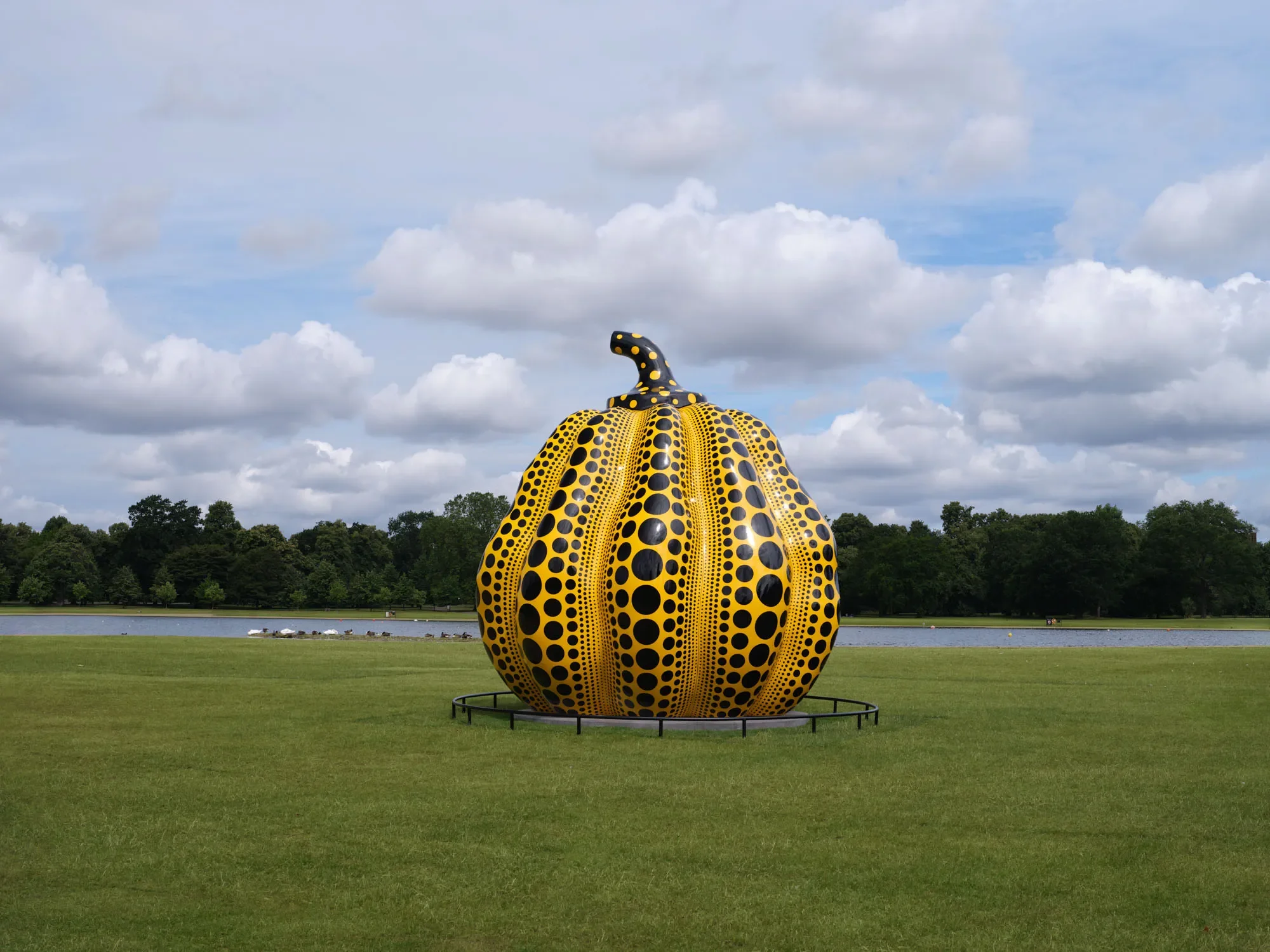
Yayoi Kusama, Pumpkin, 2024
Like Pop artists, Kusama repeatedly returns to an rdinary subject, transforming it into an instantly recognisable artistic motif. However, whereas Pop Art frequently explored the relationship between consumer culture and everyday objects, Kusama's engagement with the pumpkin is rooted in a much more personal relationship with childhood memory and identity. Kusama's relationship with the kabocha pumpkin is deeply rooted in her childhood, with her family's agricultural background and the surrounding fields of squash forming part of her early experiences. Therefore, Kusama's pumpkins do not carry the same associations with New World discovery explored earlier. Instead, the specific variety of Japanese pumpkin introduces an entirely different interpretation, one more closely associated with autobiographical elements.
Ultimately, the portrayal of the pumpkin throughout art history is far from static. What is commonly recognised today as a symbol of autumn and Halloween carries a much broader range of symbolic meanings. From its associations with colonial expansion to nineteenth-century domesticity and, more recently, Kusama’s exploration of personal identity, the pumpkin’s significance has continually evolved in representation.
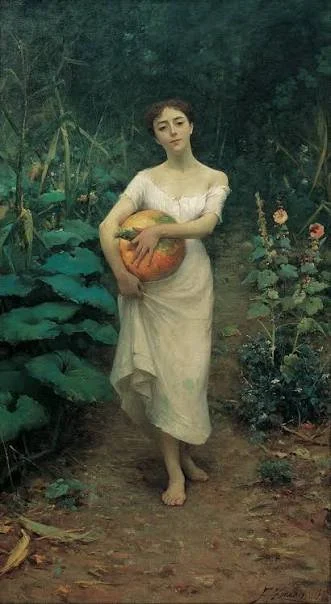
Fausto Zonaro Young Girl Carrying a Pumpkin (1889)