
Words by Fleur McQuillan
Edited by Georgina Way
The body acts as an archive of time; it carries the weight of a life lived and becomes evidence of an existence. The female body in particular can be interpreted as an archive through which memories, cultural expectations and individual thoughts and feelings are persevered and then communicated. Throughout art, women’s bodies have traditionally been idealised through other’s perspective, obscuring the individual’s experience. However, it is artists such as Frida Kahlo and Gustav Klimt who reveal the body’s capacity to communicate what lies beyond the surface; to explore the difference between physical appearance and the invisible story it contains.
Frida Kahlo’s The Broken Column explores the female body as an archive of suffering, vulnerability and lived experience. Painted in 1944, the work depicts Kahlo’s body as physically fractured with an exposed column and nails piercing the flesh. The graphic nature of the image subverts traditional notions surrounding women’s bodies being idealised and sexualised, despite the figure being nude. The nudity adds this depth, realism and shock as though the female body isn’t something to be admired, but rather something to understand as Kahlo transforms her body into a visual record of endurance. Kahlo’s exposed torso becomes a surface in which the individual’s suffering is explored. The fractured column in the place of her spine evokes strength yet stability as it appears that the column is holding her up. The barren background adds this surreal quality to the piece and allows for the body to become the primary focus whilst treating the body as more than a physical form. Furthermore, the cracks in the earth visually echo the pain in her body, constructing this relationship between a wounded individual within a damaged world. The painting could perhaps reflects the physical injuries Kahlo sustained in a bus accident in 1925, meaning that the female body functions as an archive as though the body preserves time, it means the most painful experiences are preserved. In The Broken Column, Kahlo reclaims the female body as an archive of lived experiences, transforming physical vulnerability and suffering into a potent display of endurance.
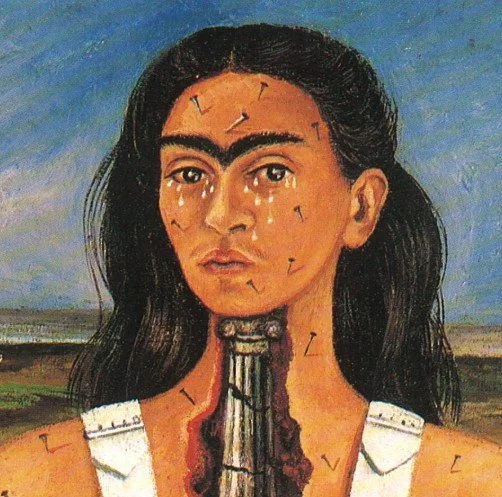
The Broken Column, Frida Kahlo, 1944
The body as an archive can further be reinforced through Gustav Klimt’s The Three Ages of Woman (1905) where Klimt explores how the female body acts as an archive through the juxtaposition of infancy, adulthood and old age emphasising how the female body acts as a living record of time. The painting depicts three female figures, the infant and the young women emphasise this sense of serenity and peace, whilst the older figure is depicted as bowing their head as though they’re ashamed and the idea with their face hidden. Together they embody the different stages of human life and examine the treatment of the female body through different periods of time. Each of the figures become markers of different temporal stages, with the child representing the beginning of life, the young woman emphasises vitality and the elderly woman emphasising the consequences of ageing. The idea that ageing is treated as something pessimistic rather than celebrated explores this notion of the body being treated as an archive as it suggests the body preserving a history that cannot be separated from its present condition. The contrast between these figures also explores the cultural valuation of female bodies, which can be limiting in the idea that the body records a passage of time as it fails to communicate the life that has been lived.
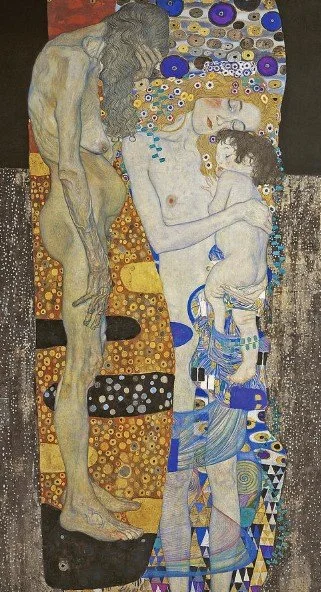
The Three Ages of Woman, Gustav Klimt, 1905
Ultimately, the body as an archive of time reveals how art has the ability to transform a physical figure into a record of lived experience and memory. The paintings demonstrate how the body holds a history that extends beyond its immediate appearance. Furthermore, the exploration of the body as an archive through a female subject emphasise the cultural ideas attached to the female body and how they play a role in transforming the way we interpret these paintings. However these paintings emphasise the limitations in making time appear visible as it fails to fully communicate the memories and experiences that constitute an individual life. Therefore, to consider the female body as an archive, is to examine what the body can remember and who possesses the authority to interpret its story; occupying a space between visibility and absence.