
Girls in Pearls: Painting Six of the Most (In)famous Faces of the mid 20th Century
Words by Georgina Way
Edited by Georgina Way
“Whenever I see a newspaper headline beginning with ‘Peer’s daughter,’ I know it will be about one of you,” is what Lady Redesdale is reported to have said one day. She was hardly exaggerating. Between 1930 and 1980, scarcely a year went by when one if not more of her daughters were making news and not all of it good.
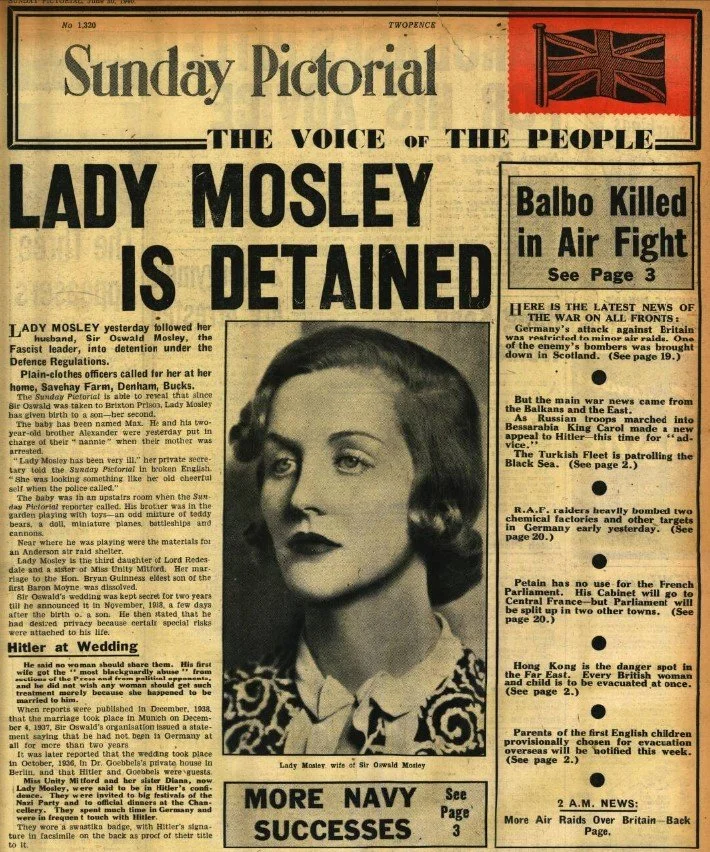
Newspaper headline announcing the arrest of Diana, Lady Mosley in 1940.
The famous Mitford Girls were six sisters born into the aristocratic Mitford family. Born between 1904 and 1920, all six of them made their mark in their own unique way. Nancy became a bestselling author with social political views. Pamela, “the most rural of them all” as quoted by John Betjeman, married the famous jockey and scientist Derek Jackson and imported chickens illegally from Switzerland. Diana married into the Guinness family before meeting Hitler, becoming a Fascist and marrying Oswald Mosley (who founded the British Union of Fascists). Unity moved to Germany, met and became enamored with Hitler, to the extent that when the war was declared in 1939, she attempted suicide. Jessica ran away to America with her cousin (a nephew of Winston Churchill) and became an ardent Communist and Deborah married Andrew Cavendish and became the Duchess of Devonshire and sister-in-law to the US President, John Kennedy.
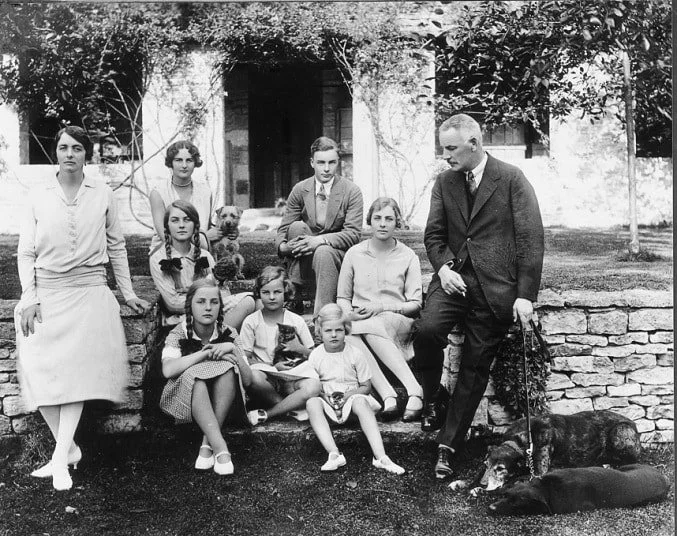
The Mitford Family, c. 1925
The faces of these women dominated the British and, at points, the world’s media, for the best part of half a century. Countless portraits have been painted, pictures photographed but none are so well-known or poignant as the six pencil portraits drawn by William Acton in 1938.
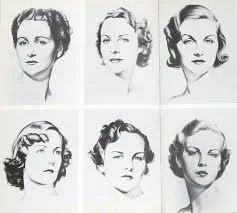
The Mitford Girls, by William Acton.
Top left to bottom right: Nancy, Pamela, Diana, Unity, Jessica & Deborah
The sisters had slowly but surely been drawing more and more attention to themselves since 1930 and by the time Lady Redesdale commissioned Acton to draw the portraits, hard feelings amongst the sisters were already rife. In fact, the portraits were finished only just in time because a couple of months later, Unity moved permanently to Germany and Jessica ran away to America and the sisters would never be together, let alone in the same country, ever again.
The pencil portraits have been extensively published and reproduced. Diana used the portrait of her for the front cover of her autobiography The Pursuit of Happiness. It is interesting to see how Acton transcribed each sister’s unique personality onto the paper because, although on first glance they all look quite similar, once you really look at them, you can see just how different they all are.
Nancy, famous for having a witty but incredibly sharp and caustic tongue is depicted in a strong, independent and yet strangely vulnerable pose as her eyes gaze out to the viewer. It very much reflects her personal life which, despite being a very successful author, was rather tragic. Pamela, rural and gentle, is depicted softly with a mystical side to her. Yet the soft shading does not hide the quietly determined streak which grew as the years went by. Diana’s portrait was the first one to be drawn and Acton has really highlighted her exceptional beauty and strength. Unity gazes out to the distance which could be a metaphor for her life. As a young woman, she never enjoyed being photographed or painted and here you can see that her mind is very much on something else. By 1938, she was almost always in Germany and disliked coming back to England for any period of time. Her devotion to Hitler and to the Nazi Party led to the British media propaganda-style cartoons of her with captions such as “Hitler’s British Mistress.” These depictions of her became the famous ones and Acton’s portrait of her and of the private Unity remained largely forgotten. Jessica’s rebellious and angry streak is clear to see in the fifth portrait. Like the majority of girls of her class at the time, she had not been allowed to go to school and instead had been educated by a series of governesses. By 1938 she was resentful and bored and that feeling of entrapment and yearning to get away is all too clear to see in the portrait. Finally, Deborah’s portrait depicts the eighteen year old at the height of her beauty. It was the year she was presented at court and met her future husband.
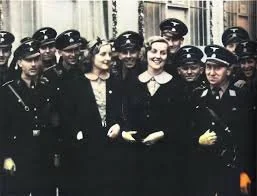
Unity and Diana at a Nazi Rally, c. 1935
There have been many subsequent photographs and depictions of the sisters but none capture their personalities quite like Acton’s portraits. Nor do they depict a moment of great change - for both the family and the world. The portraits capture a fleetingly still moment in history. When Deborah, the last surviving sister, died in 2014, so too did a huge part of history. Between them, the Mitford sisters had met many of the big political and cultural faces of the 20th Century from Churchill to JFK, Hitler, Maya Angelou, Queen Elizabeth, Evelyn Waugh, Elvis Presley and Cecil Beaton to name but a few.
Due to their extreme political differences, there were unresolved feuds amongst the sisters with Jessica never speaking to either Unity or Diana again after she ran away. These portraits represent both the great love and strength of family but also the incredible pain and hurt families are capable of inflicting upon each other. What started out as portraits of six sisters have turned into political and historical images, telling the story of one of Britain’s most unique and eccentric families.
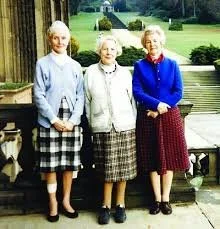
Diana, Pamela and Deborah, 1980s